
HEAD OF A LUOHAN
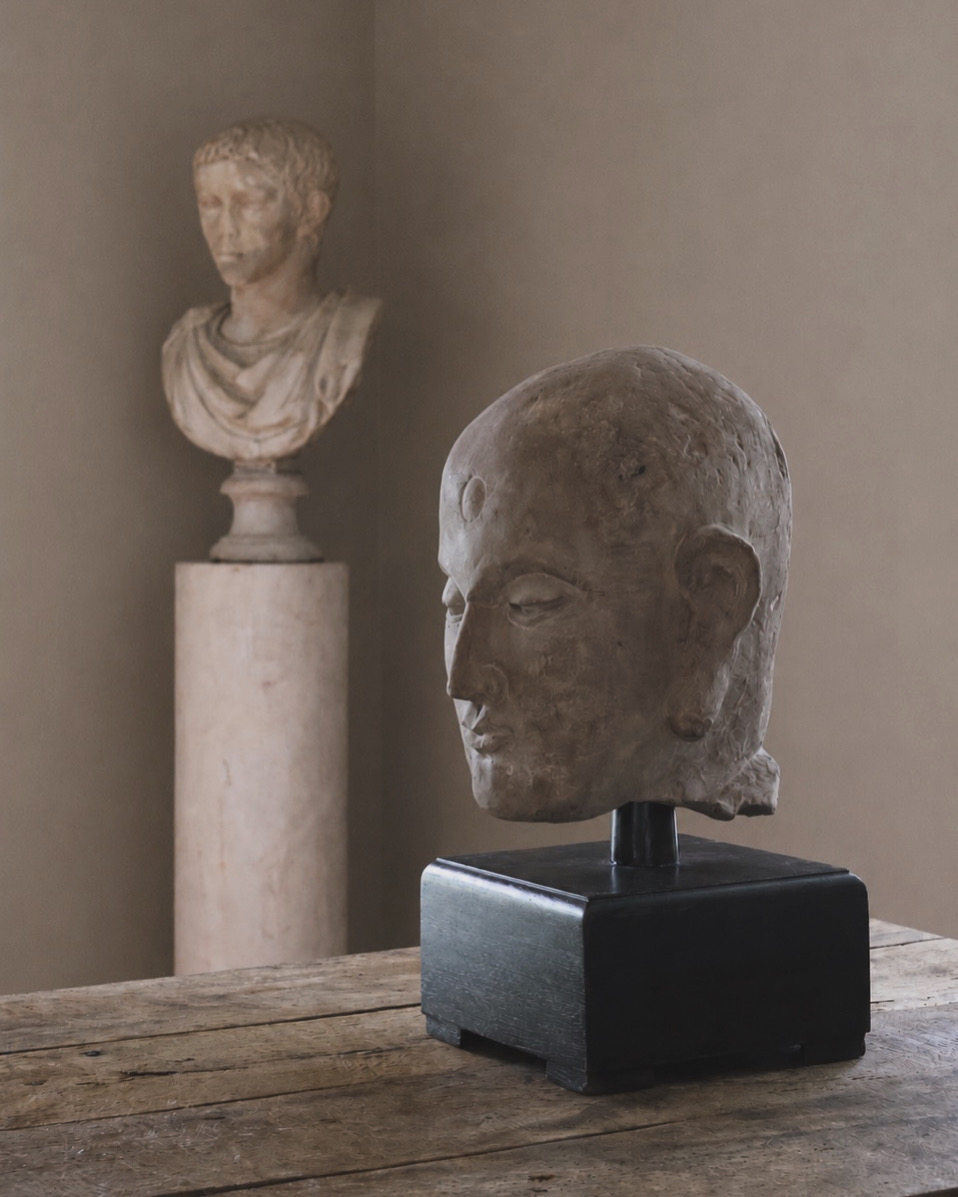
HEAD OF A LUOHAN
China, early Qing
Material
Sandstone
Dimensions
Height 29,3 cm excluding stand
Provenance
– Private collection Brussels, Belgium
– Belgian art market, 2025
Description
This striking Luohan head represents one of the most enduring subjects in Chinese Buddhist art. The term Luohan, derived from the Sanskrit Arhat, refers to a disciple of the Buddha who has attained a high level of spiritual realization through meditation, discipline, and the teachings of Buddhism.
The tradition of depicting Luohans developed particularly strongly in China, where they became revered not only as enlightened disciples of the historical Buddha, Shakyamuni, but also as protectors of the Buddhist Dharma. In Chinese Buddhist tradition, groups of sixteen or eighteen Luohans became especially popular, and their images were placed in temples alongside representations of the Buddha.
Unlike the Buddha, who is generally portrayed according to an idealised and highly codified iconography, Luohans are often depicted with remarkably individualised and human features. Their faces can appear aged, austere, contemplative or even unconventional. This emphasis on individuality reflects their position between the human and the sacred: they have achieved spiritual awakening, yet remain recognisably human.
This particular head is especially compelling for its quiet intensity and contemplative expression. The subtly modelled features, closely cropped hair and elongated ears evoke the traditional visual language of Buddhist monastic figures, while the weathered surface lends the sculpture a strong sense of age and character.
The elongated earlobes, frequently seen in Buddhist imagery, are associated with an advanced spiritual state and are traditionally understood as an indication of wisdom and detachment from worldly concerns.
Beyond its religious symbolism, the Luohan has a remarkable place within the history of Chinese sculpture. From the highly naturalistic Luohans of the Liao and Song periods to later Ming and Qing interpretations, artists used these figures as an opportunity to explore personality, expression and the human face in ways rarely seen in representations of other Buddhist figures.
A sculptural portrait of wisdom, discipline and inner awakening — carrying with it the centuries-old tradition of Chinese Buddhist art.